Château d’Auvernier: When Four Centuries of History Come to Life on a Bottle
For more than four centuries, Château d’Auvernier has embodied the excellence of Neuchâtel’s winemaking tradition. Its history began in 1559, when Blaise Junod, Governor of the Lordship of Valangin, commissioned the construction of the château. A few decades later, in 1603, the estate was acquired by Pierre Chambrier, marking the beginning of a family legacy that continues to this day. At that time, the estate already included nearly seven hectares of vineyards, with its wines being sold both in Switzerland and abroad.
Over the generations, the Chambrier family and their descendants have preserved the soul of the Château despite changes in name and era. Captains serving France, Savoy or the United Provinces, governors of the Principality of Neuchâtel, chamberlains to the King of Prussia, and even a friend of Jean-Jacques Rousseau: many remarkable figures have shaped the estate’s history. Yet one thing has remained unchanged for more than 400 years: wine continues to be the very heart and purpose of Château d’Auvernier. This commitment to preserving a living heritage and passing on centuries of winemaking tradition still guides the philosophy of the Caves du Château d’Auvernier today. At the head of the estate, Henry Aloys Grosjean, representing the 15th generation, safeguards this family heritage and continues a craft that has been handed down for more than four centuries.
The 1603 Collection: A Tribute to a Landmark Date
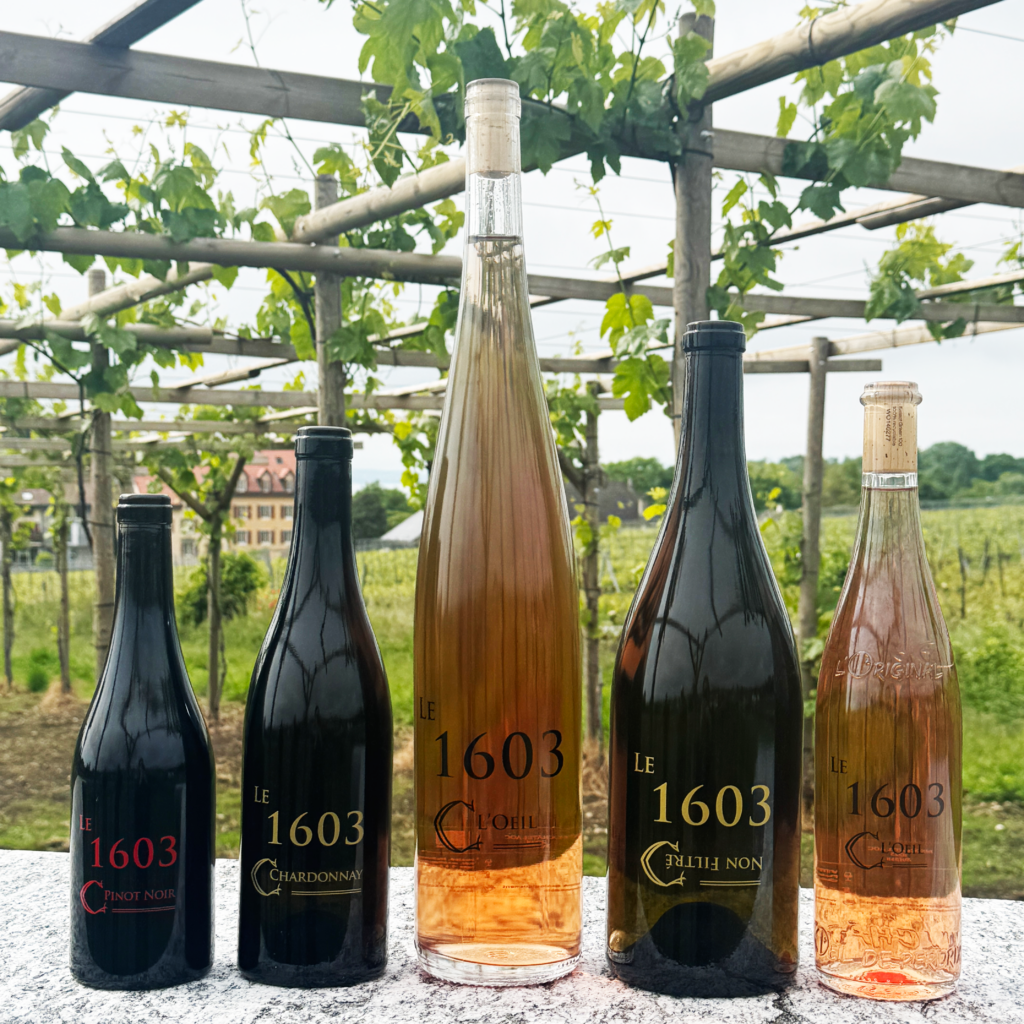
To pay tribute to the year 1603, which marks the family’s arrival at the Château, Henry Aloys Grosjean created a special wine collection named 1603. To give this new range a distinctive identity, he turned to Univerre to design a bottle worthy of its remarkable history.
At the outset, the choice between a traditional label and decoration applied directly onto the glass had not yet been made. After discovering the many creative possibilities offered by screen printing, Henry Aloys Grosjean ultimately chose this technique to enhance his bottles. Throughout the project, a true collaborative partnership developed with the Univerre teams. Thanks to the production of several samples, colours were refined, finishes adjusted, and the final result validated to ensure it faithfully reflected the original concept. This close collaboration and flexibility made it possible to create a bottle that perfectly expresses the identity of the 1603 collection.
A Minimalist Design That Appeals to a New Generation of Consumers
The result is a bottle with a refined, elegant and distinctly contemporary look. Its design focuses on the essentials: the number 1603 takes centre stage, accompanied by the winery’s logo and the wine’s name. Available in several finishes, including red, black and gold-effect printing, the screen printing gives the bottle a premium appearance while maintaining a clean and understated design.
Beyond its visual appeal, this new identity has been extremely well received by consumers. The 1603 collection has enabled the Caves du Château d’Auvernier to attract a younger clientele, particularly those who are highly sensitive to bottle design. Thanks to this approach, the winery has successfully reached an audience it previously found more difficult to engage, demonstrating that packaging can be a powerful tool for showcasing a historic heritage while meeting the expectations of today’s consumers.
FAQ: Wine Bottle Customisation
Why customise a wine bottle?
Customising a bottle creates a strong visual identity and helps a wine stand out on the shelf or during tastings. Beyond its aesthetic appeal, it highlights the winery’s history, strengthens brand image and improves recognition among consumers.
What are the advantages of screen printing on glass?
Screen printing offers several advantages:
- A premium finish printed directly onto the glass;
- Excellent resistance to moisture, abrasion and the effects of time;
- Extensive creative freedom thanks to a wide range of colours and finishing options;
- An enhanced design without the need for an additional label.
How does a bottle customisation project work?
Bottle customisation is generally carried out in several stages: defining the design, selecting the decoration technique, producing samples, refining colours and finishes, and finally validating the result before production begins. This sampling phase ensures that the finished product fully meets expectations.
Does a customised bottle influence sales?
Yes. Bottle design plays an important role in purchasing decisions, especially for consumers discovering a brand for the first time. A carefully designed bottle attracts more attention, improves product recall and can help win over new customers, as demonstrated by the success of Château d’Auvernier’s 1603 collection.
How do you choose the best decoration technique for a wine bottle?
The choice depends on several factors, including the desired brand image, budget, production volumes, bottle type and preferred finishes. Technical guidance from the earliest stages of the project helps identify the most suitable solution.
Why has packaging become such an important element in the wine industry?
Today, packaging is no longer just about protecting the product. It tells a story, communicates the values of a winery and contributes to the overall purchasing experience. A well-designed bottle helps a wine stand out in a competitive market while reinforcing consumers’ perception of its quality.