Or is it simply that the world around wine has changed ?
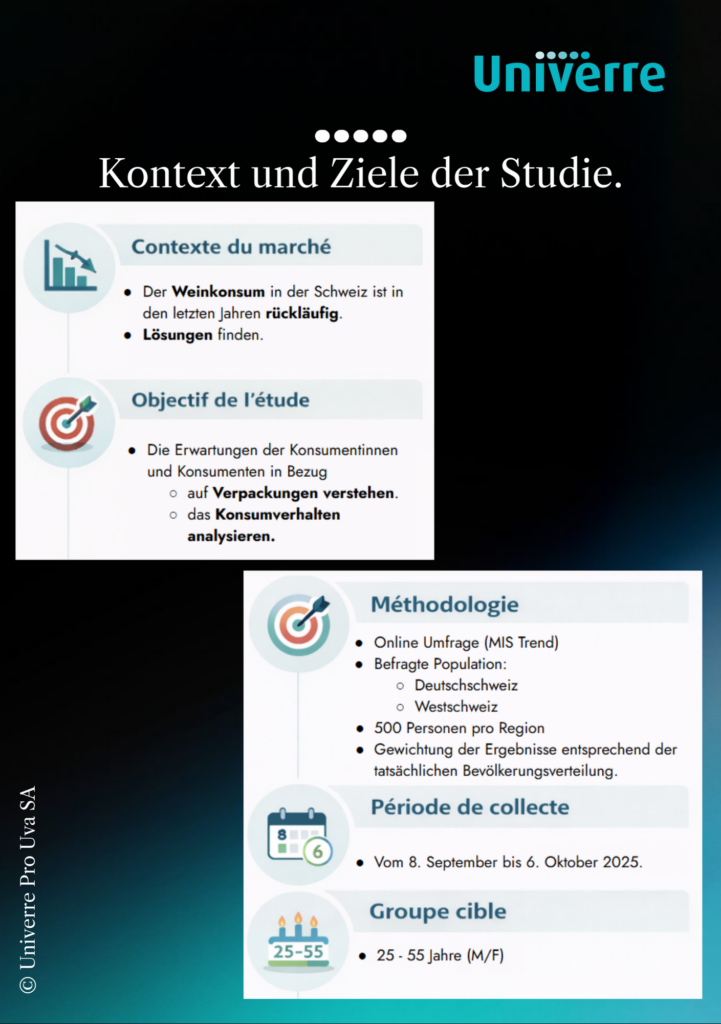
“Wine consumption is declining.” You see this headline everywhere. It sounds self-evident, almost inevitable. But what if this statement only told part of the story? What if the real question were not why we drink less wine, but how to continue – or even improve – sales in a market that has become more selective?
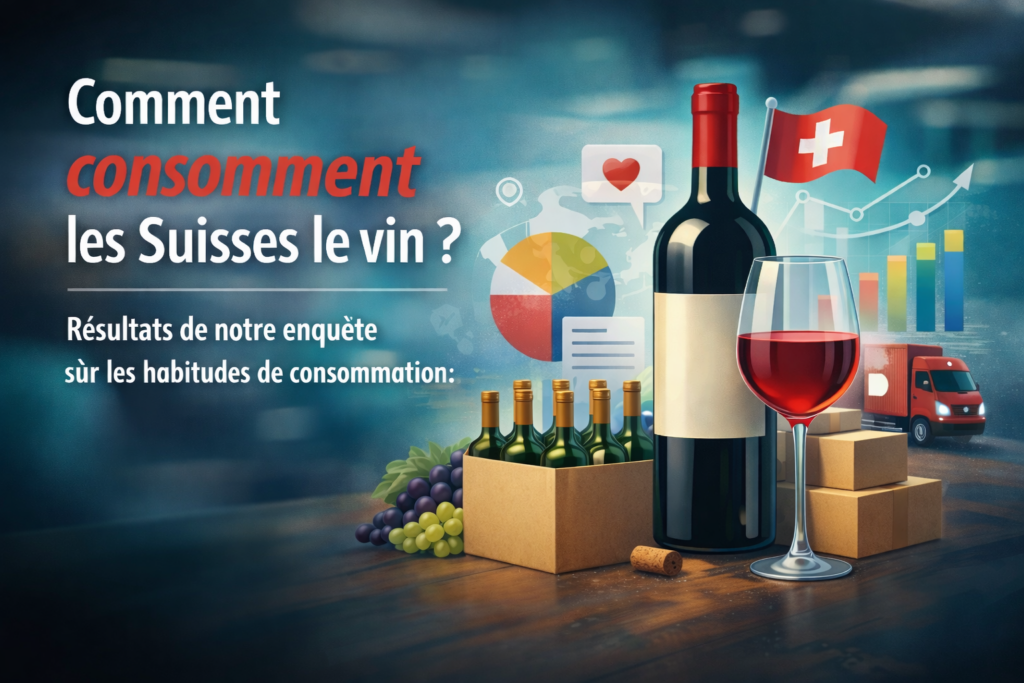
This is exactly what the major national survey conducted by Univerre Pro Uva SA on drinking habits and beverage market trends highlights. The findings are clear: the problem is not wine itself, but the way it is offered, presented and valued today.
Carried out in both French- and German-speaking Switzerland among 1,000 people, the study analyses in particular the role of packaging in trust, perceived value and purchasing decisions. It confirms a fundamental shift: we are moving from a volume-driven market to a value-driven one, in which packaging becomes a strategic lever.
This shift was also discussed publicly at our Agroforum on 27 January 2026 at Agrovina, organised around a round-table discussion with four speakers:
- Nadine Bridy, Head of the Valais Office of Vine and Wine
- Michel Schurch, Oenologist, Wine Consultant and Founder of The Legend Wine
- Michael Hock, Oenologist and Managing Director of St. Jodern Kellerei
- Olivier Mounir, Winegrower and Owner of Cave du Rhodan
The tone was set from the very start:
« Today, the question is not how much we sell, but how we sell. »
Wine is not disappearing: it is no longer automatic
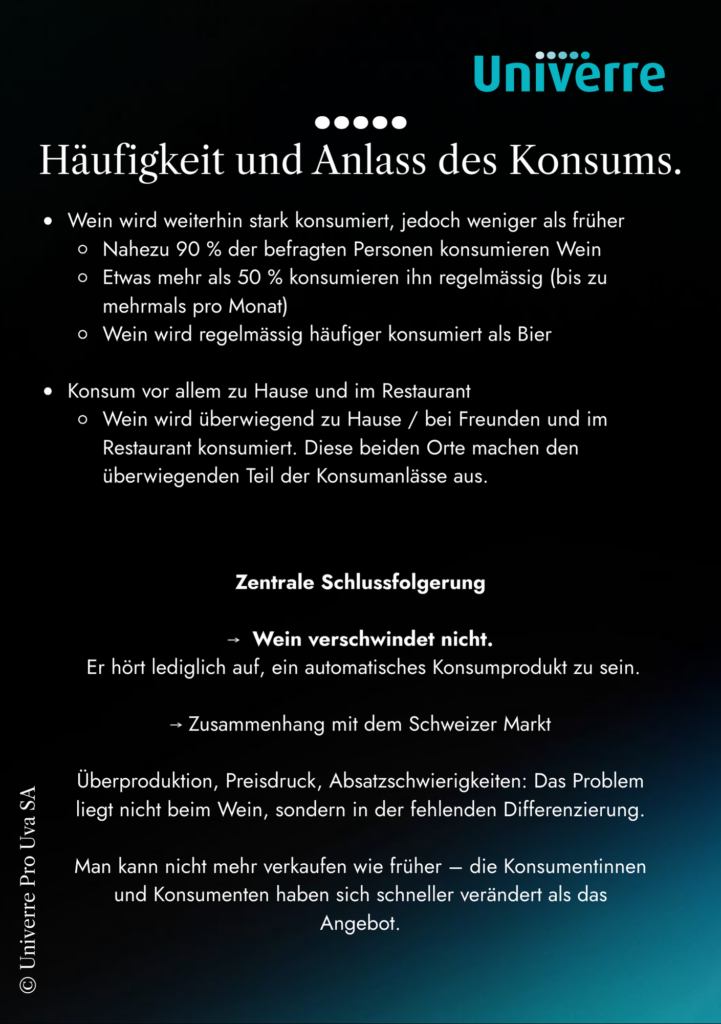
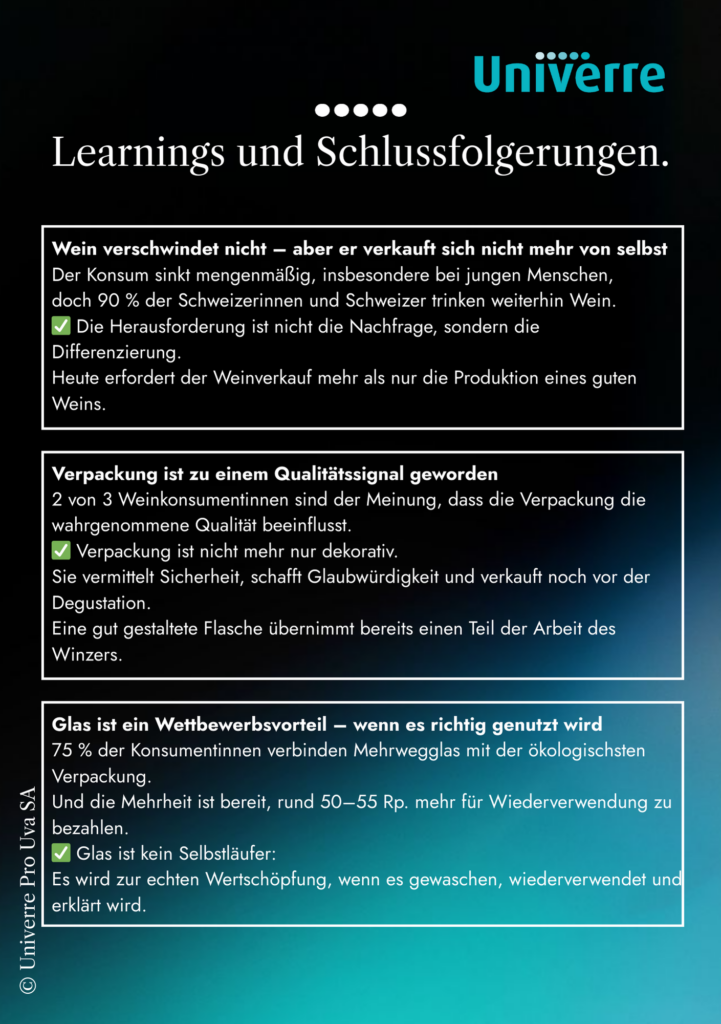
The first key insight: despite declining volumes, wine remains deeply rooted in consumption habits.
- Nearly 90% of respondents drink wine
- More than 50% drink it regularly
- Consumption occasions are very stable: at home / with friends, followed by restaurants, clearly dominate
And yet volumes are stagnating, or even falling. Why?
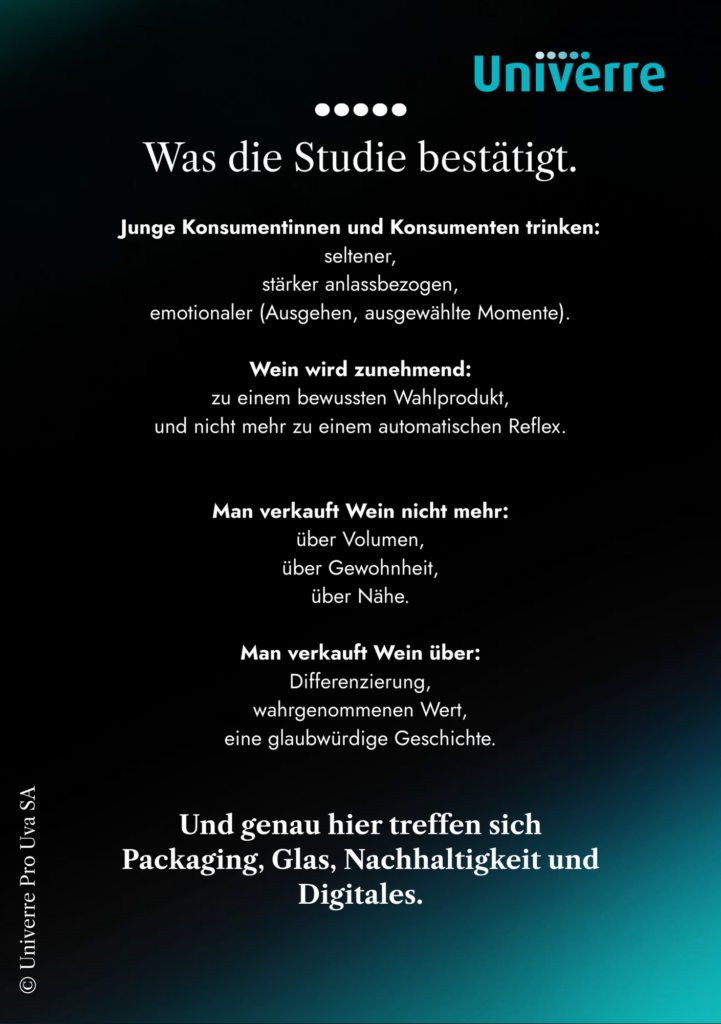
Because wine is no longer a reflex product. It has become a product of choice: more intentional, more selective.
- more considered
- less frequent
- strongly linked to specific occasions
This interpretation was confirmed during the round table. For Nadine Bridy, the decline is not just a generational issue but a deeper structural shift: “I don’t think this is a change in wine consumption; it’s a societal change (…) and we have to adapt to it.”
Among younger generations in particular, wine is no longer bought out of habit, but for specific moments: an evening with friends, an event, a chosen experience.
👉 Wine loses volume, but gains meaning.
And this is exactly what Nadine summed up in one sentence: “I think they are looking for experiences. And that’s where wine has a role to play.”
What triggers the purchase: trust and visible signals
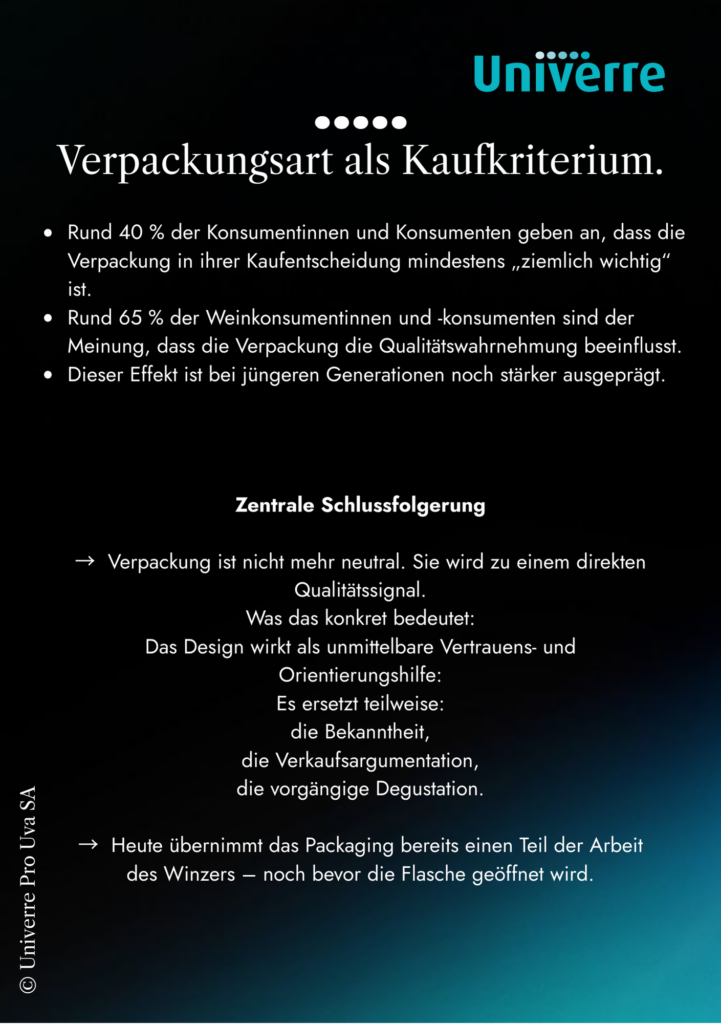
Packaging is no longer neutral – it helps sell
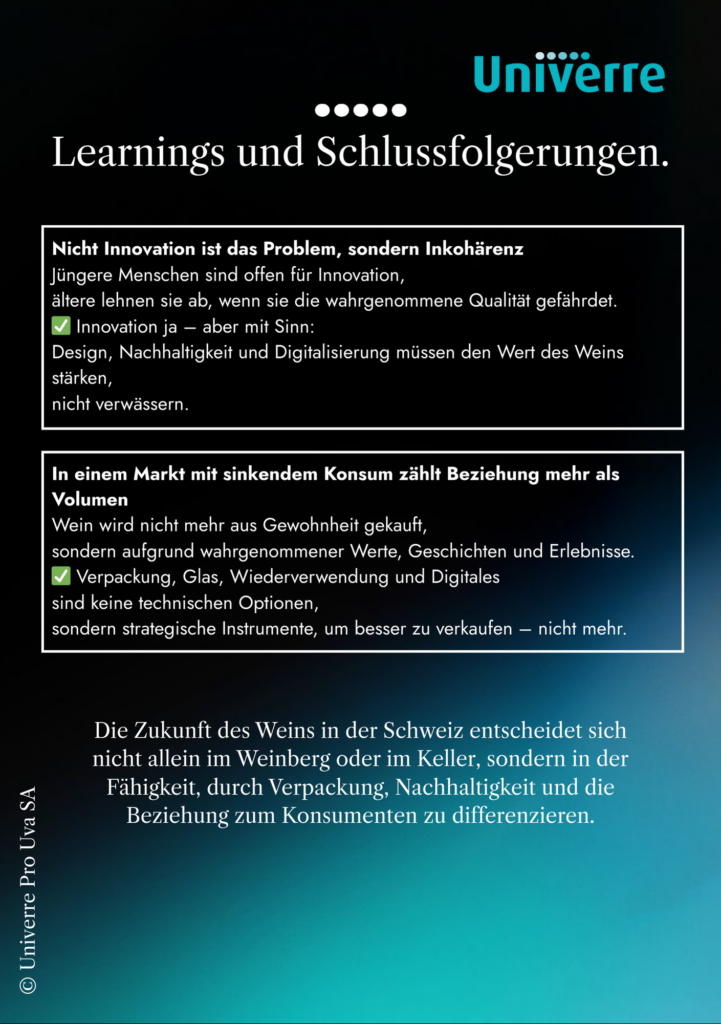
In a more demanding market, decisions are driven by perceived quality. And the study confirms that this perception is strongly linked to packaging.
- For regular consumers, the type of packaging influences perceptions of quality – and this is particularly true for wine. And the study confirms that this perception is strongly linked to packaging.
- Even when packaging is not spontaneously cited as a main criterion, it acts as immediate reassurance: it “sells” before tasting, partly replacing brand awareness, sales discourse or trial.
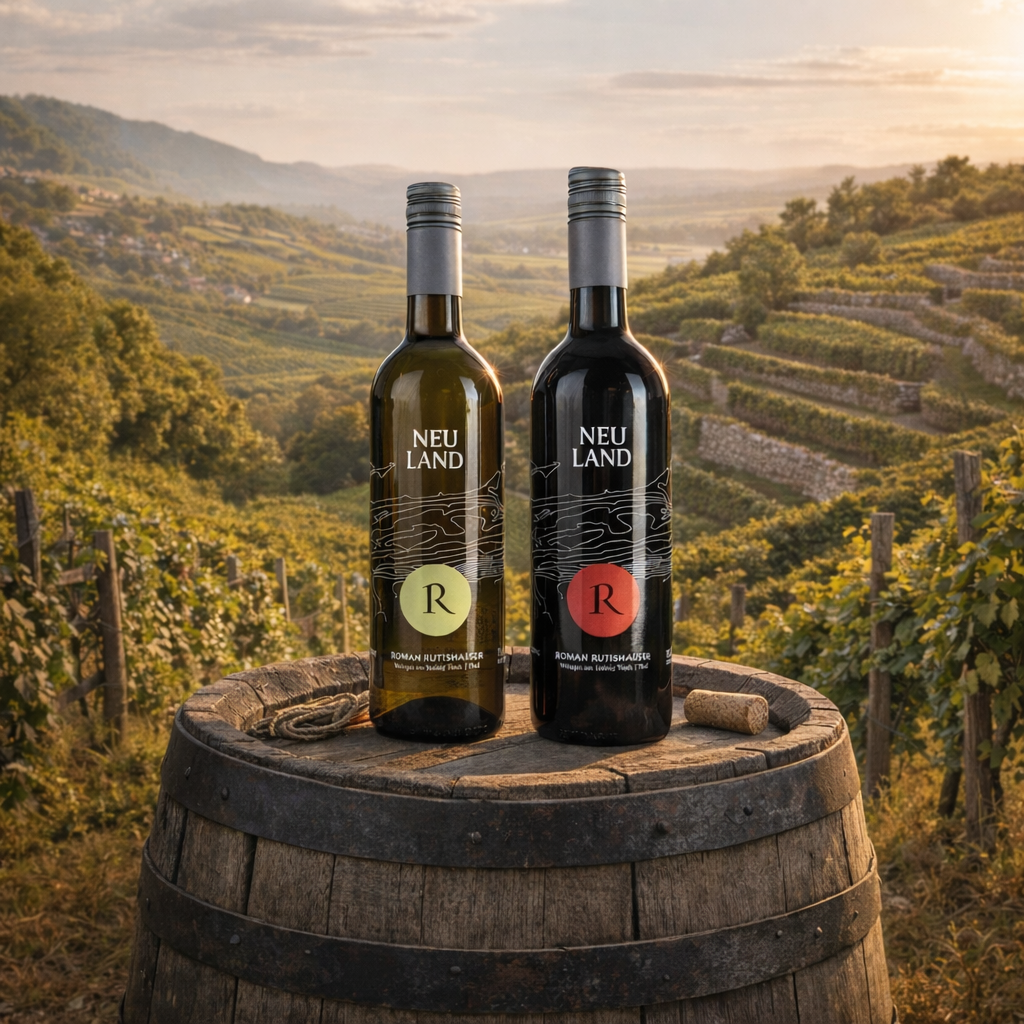
In concrete terms, packaging is no longer decorative. It becomes a direct signal of quality and a tool for legitimising price.
This is exactly how Michel Schurch put it in very simple terms: “The first contact we have with a bottle is its visual (…) when the visual is clean, it brings a certain credibility.”
And behind that first glance, there is already a promise: “There is already a visual storytelling in place.”
In practice:
- design partly replaces brand awareness
- it compensates for the absence of tasting
- it builds trust even before the bottle is opened
👉 Today, the bottle already does part of the winegrower’s work.
Glass: a competitive advantage – provided its value is proven
When consumers are asked which packaging formats are perceived as the most environmentally friendly, the verdict is very clear:
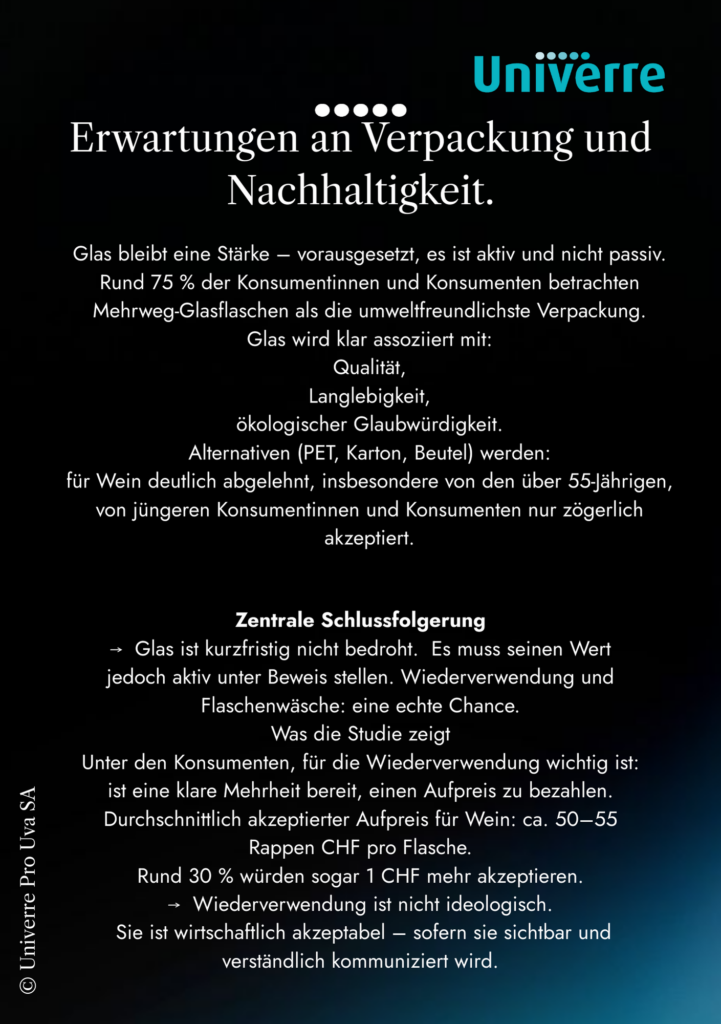
- Returnable glass bottles are “by far the most frequently cited” environmentally friendly packaging
- 75% of consumers consider the reusable glass bottle to be the most ecological option
Glass remains strongly associated with quality and environmental credibility. But this capital is no longer sufficient on its own: it must be made visible, understandable and linked to concrete action.
👉 It must be visible, understandable and connected to a tangible approach.
Michael Hock underlined this very concretely when speaking about the circular economy: “If we really want to do something for sustainability (…) we are convinced that bottles have to be reused.”
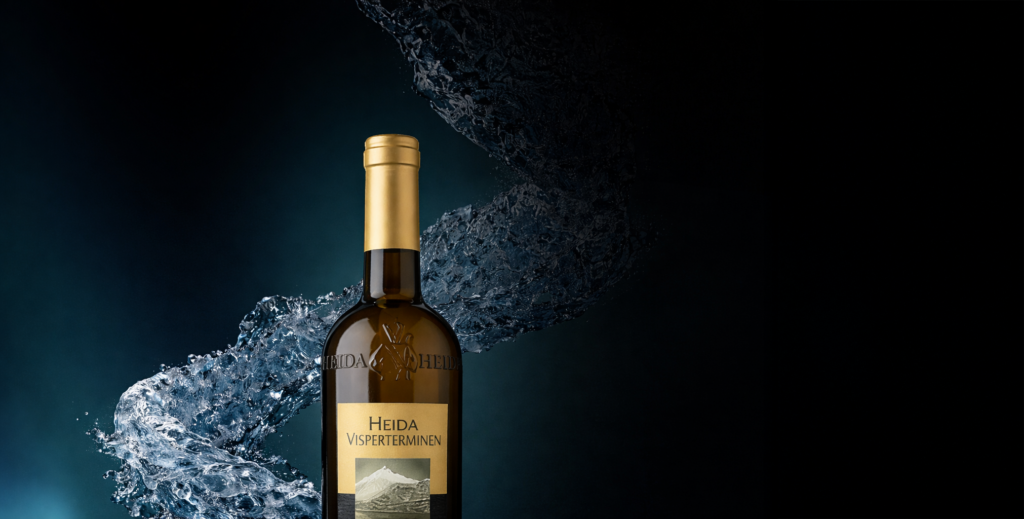
Bottle reuse and washing: turning sustainability into a sales argument
Sustainability influences purchasing decisions – but only on one condition: that it is credible, visible and understood.
The study highlights a decisive point:
- Among regular wine consumers for whom reusability matters, a clear majority would be willing to pay a premium if the bottle is washed and reused.
- The average accepted amount is around CHF 0.55
- Nearly 30% would even accept CHF 1 more
This finding reflects on-the-ground reality. As Michael Hock notes, reuse is not just symbolic; it is a powerful lever for impact: “We can save almost 90% of the energy if we wash our bottles.”
Reuse is not merely an “eco-friendly extra”: it can become a sales argument and a driver of perceived value – provided it is explained (education) and embedded in a coherent narrative.
👉 Sustainability is not ideological. It is economically acceptable – if it is visible and understood.
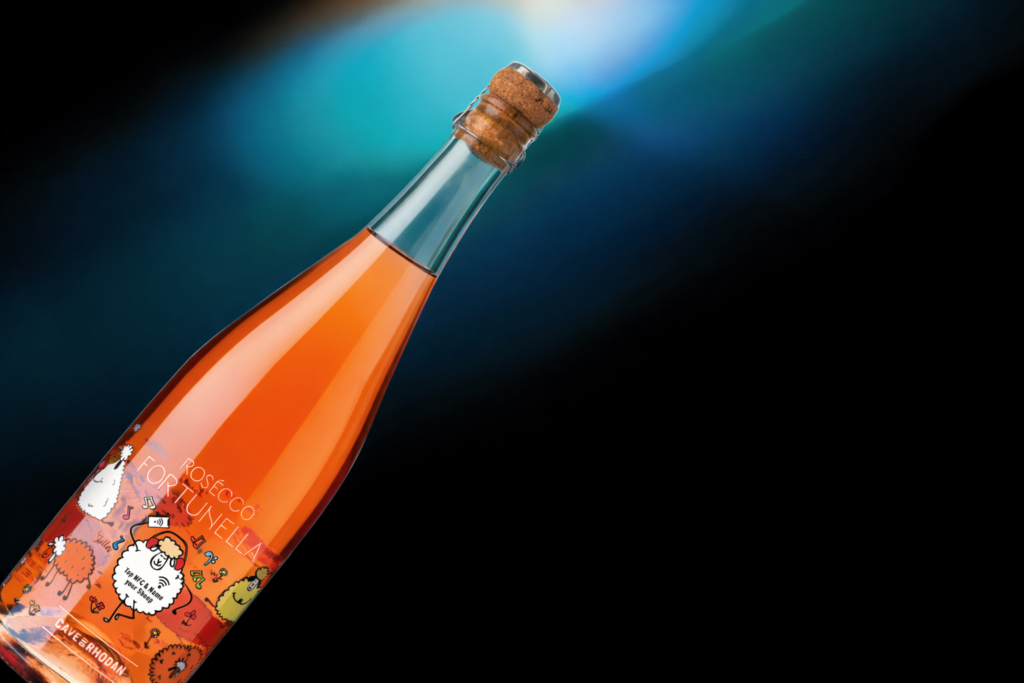
Innovation: not a gimmick, but a tool for trust and connection
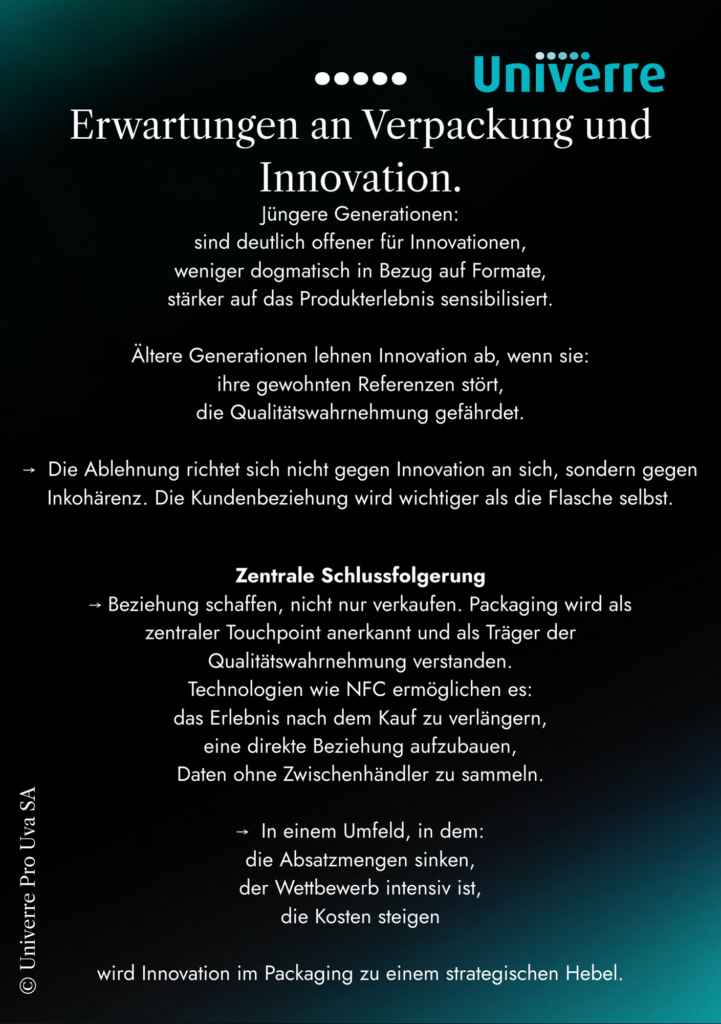
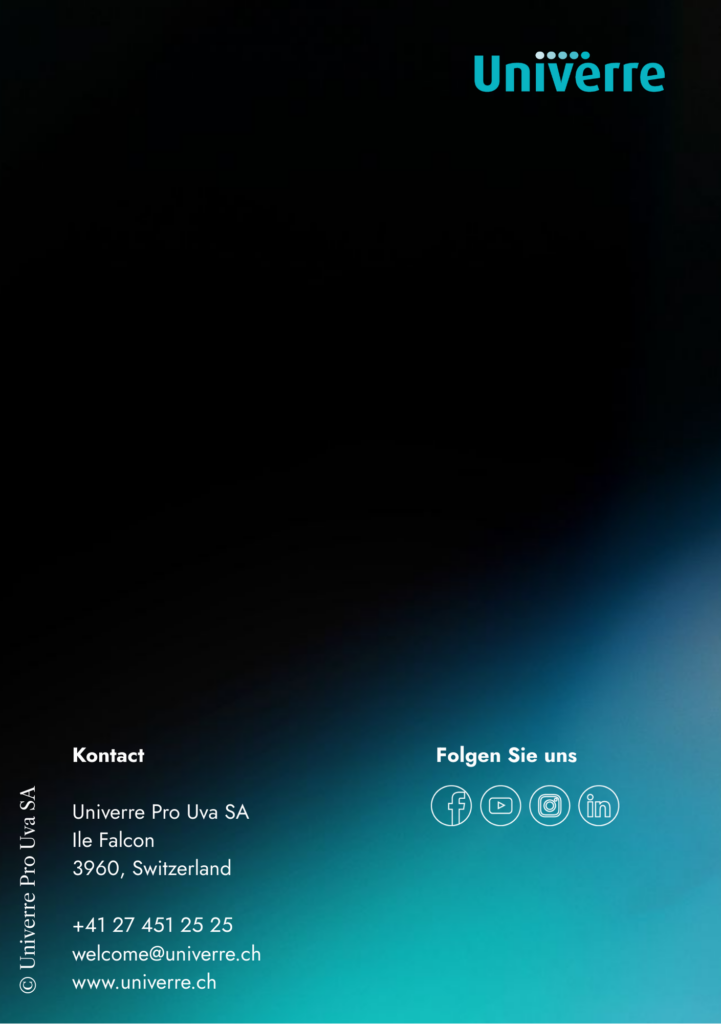
The study shows that innovation is not rejected outright. However, it is only accepted if it meets a very specific expectation: giving meaning. In other words, innovation becomes relevant when it helps explain the product better, strengthen trust and create a connection with the consumer.
This is also the stance defended by Olivier Mounir: before technology comes intention – emotion and authenticity.
As he put it simply: “The emotion, the story you can tell with it… that’s a truly indispensable asset.”
Two clear observations emerge:
- Alternative wine packaging formats generate little support: whatever the formats tested, outright rejection exceeds acceptance
- Openness is strongly generational: younger consumers are more receptive to change, while older generations reject proposals that disrupt their quality benchmarks more strongly
The issue, therefore, is not “to innovate or not to innovate”, but to innovate without inconsistency. When design, sustainability and innovation tell the same story, innovation enhances value instead of diluting it.
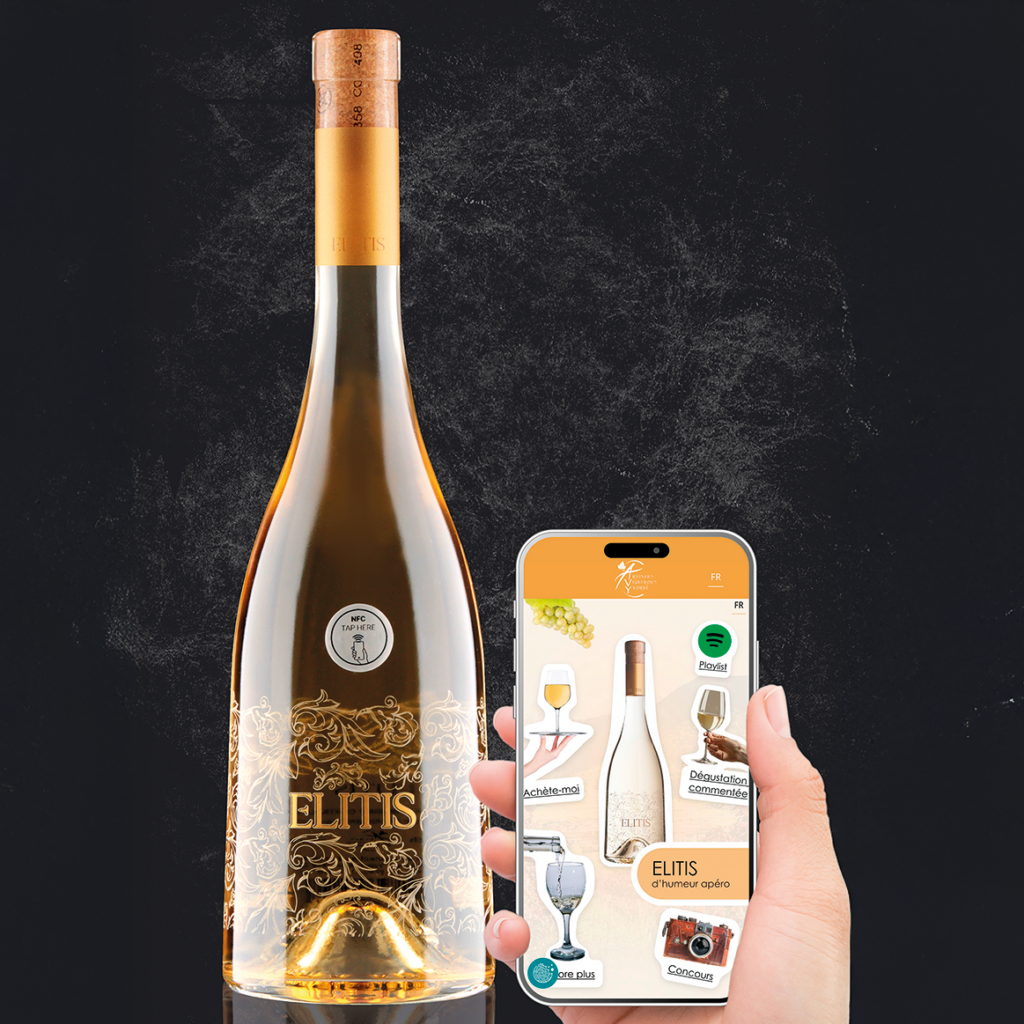
Above all, the most useful innovation is not necessarily a new format. It is the one that turns packaging into a point of contact – a medium that extends perceived quality after purchase. NFC technology, for example, can:
- extend the experience (content, advice, origin, practices)
- create a direct relationship between producer and consumer
- collect data without intermediaries
As Olivier said, the key advantage is simple: “The emotion, the story you can tell with it.”
In a context of declining volumes, intense competition and rising costs, this relationship becomes a strategic asset: creating connection, not just selling.
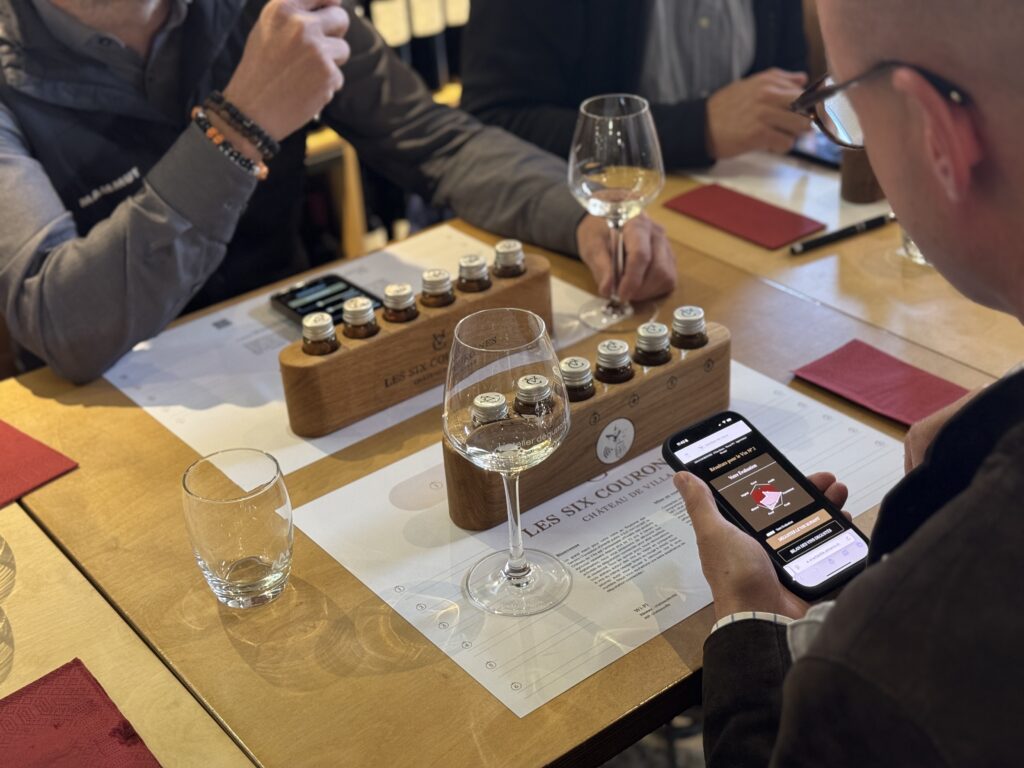
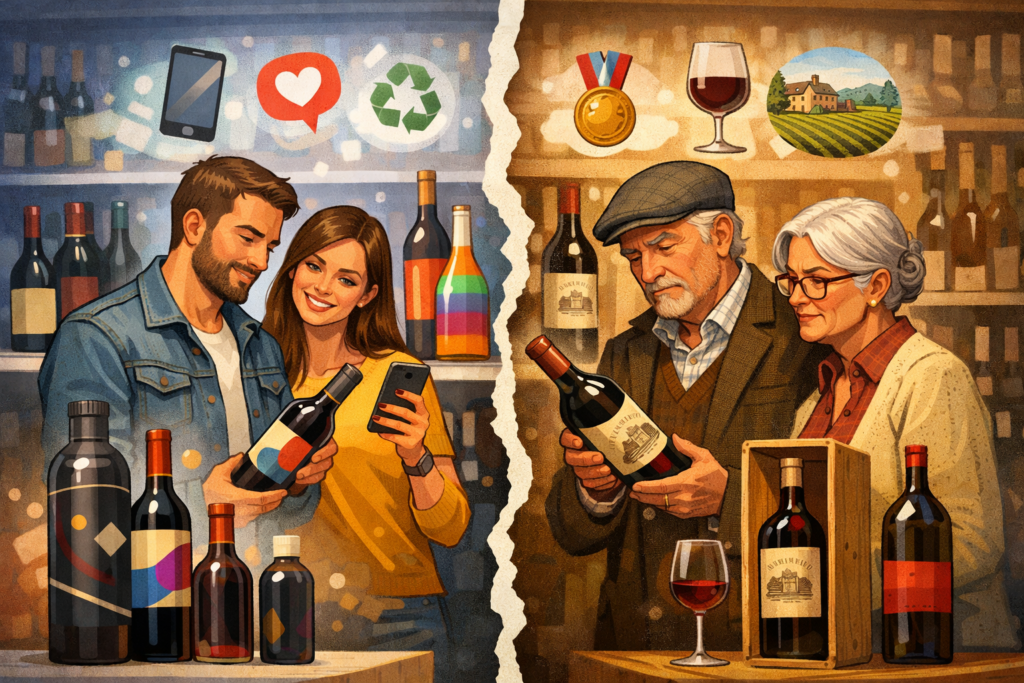
Generations: two visions of wine… and of packaging
The study reveals a clear divide: not all generations read packaging in the same way.
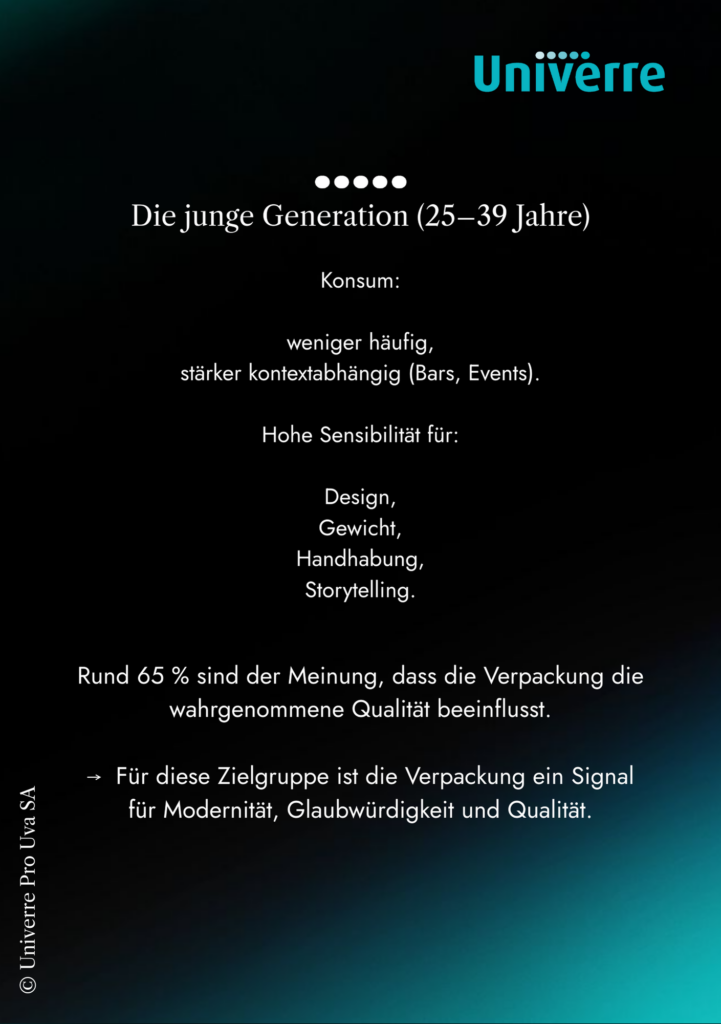
- Among 25–39-year-olds, packaging weighs more heavily in decision-making. They are more likely than other age groups to consider design, shape and colour important, and they also place greater emphasis on practical criteria such as packaging that is “not too heavy”.
👉 For them, packaging becomes a visible signal of modernity, coherence, authenticity and, more broadly, a brand experience.
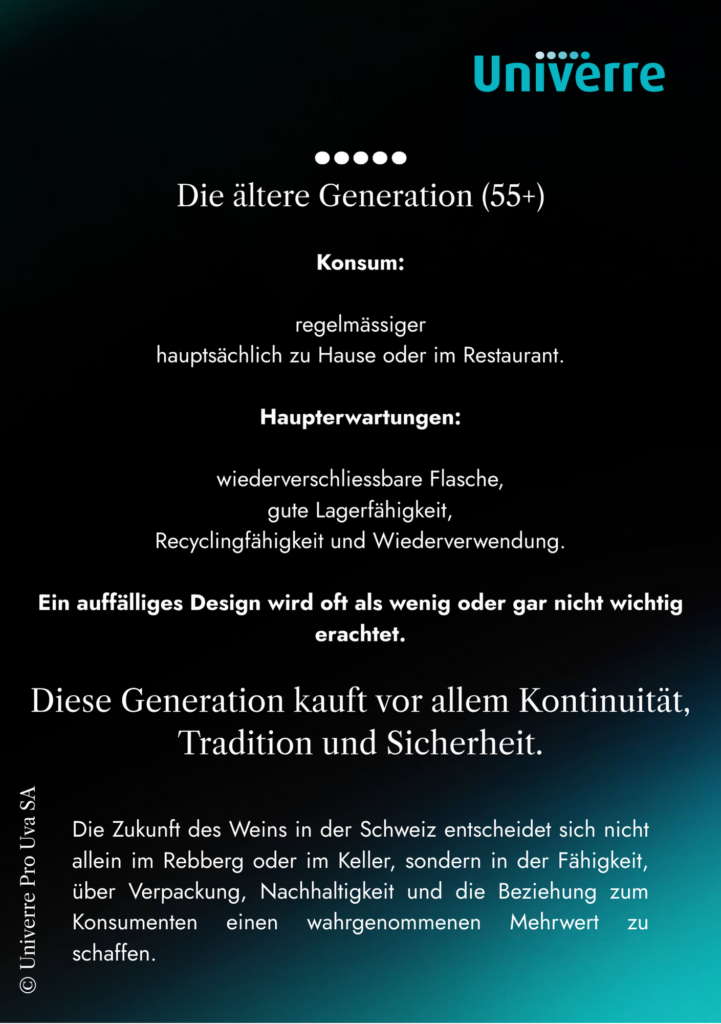
- Among those aged 55 and over, the opposite trend is observed. They are more likely to consider design as having little or no importance and favour stable reference points (perceived quality, continuity, traditional codes).
👉 As soon as packaging or format disrupts these reference points, rejection often follows, as it may be perceived as a threat to quality.
In summary: younger consumers are more receptive to design signals and change, while older generations accept change only if it does not destabilise their quality benchmarks.
What does this mean for wine producers ?
Today, wine is no longer sold through:
- volume
- habit
- proximity
But through:
- differentiation
- perceived value
- a credible story
This is precisely where packaging, glass, sustainability and digital tools converge.
Conclusion: the future of wine is not decided solely in the cellar
Nor only in the vineyard. Nor only in winemaking.
In a market where volumes are tightening, performance will no longer come solely from the product, but from the ability to create perceived value. What the survey confirms is that packaging is now far more than a container: it is a lever of trust, a tool for differentiation and a signal of quality. The challenge lies in creating strong perceived value through packaging, sustainability and customer relationships.
In practical terms, selling better tomorrow will require:
- packaging that reassures and builds credibility at first glance
- glass whose advantages are activated (deposit schemes, reuse, proof)
- sustainability that is visible, understood and therefore accepted
- useful innovation that explains, connects and strengthens relationships
Wine is not disappearing. But it demands more coherence. More clarity. And better answers.
What the conference of 27 January 2026 ultimately reminded us is that everything converges towards the same idea: “Wine is a product of connection” and that packaging, reuse and innovation are now concrete ways of recreating (or maintaining) that connection.
In short: wine will no longer be sold out of habit, but by choice. And in a world where we drink less but choose more carefully, packaging becomes one of the very first moments of sale – before opening, before tasting, sometimes even before comparison.
And concrete solutions? Univerre gives wine its value back
1. Active glass rather than a passive bottle
Univerre turns glass into a sales argument:
- reuse and industrial washing solutions
- clear communication around the life cycle
- measurable environmental benefits
➡️ Glass becomes a value lever, not just a cost.
2. Packaging as a strategic point of contact
Thanks to digital printing and screen printing:
- differentiation directly on the bottle
- no label peeling off
- design that inspires trust and quality
➡️ The bottle speaks before the wine.
3. Creating a relationship, not just a sale
With digital solutions such as NFC:
- storytelling after purchase
- extension of the product experience
- direct, intermediary-free relationship with the consumer
➡️ Wine is no longer just consumed – it is experienced.